 Surprise Golf Cart Repair
 Golf Cart Brake & Tire Service at Your Home
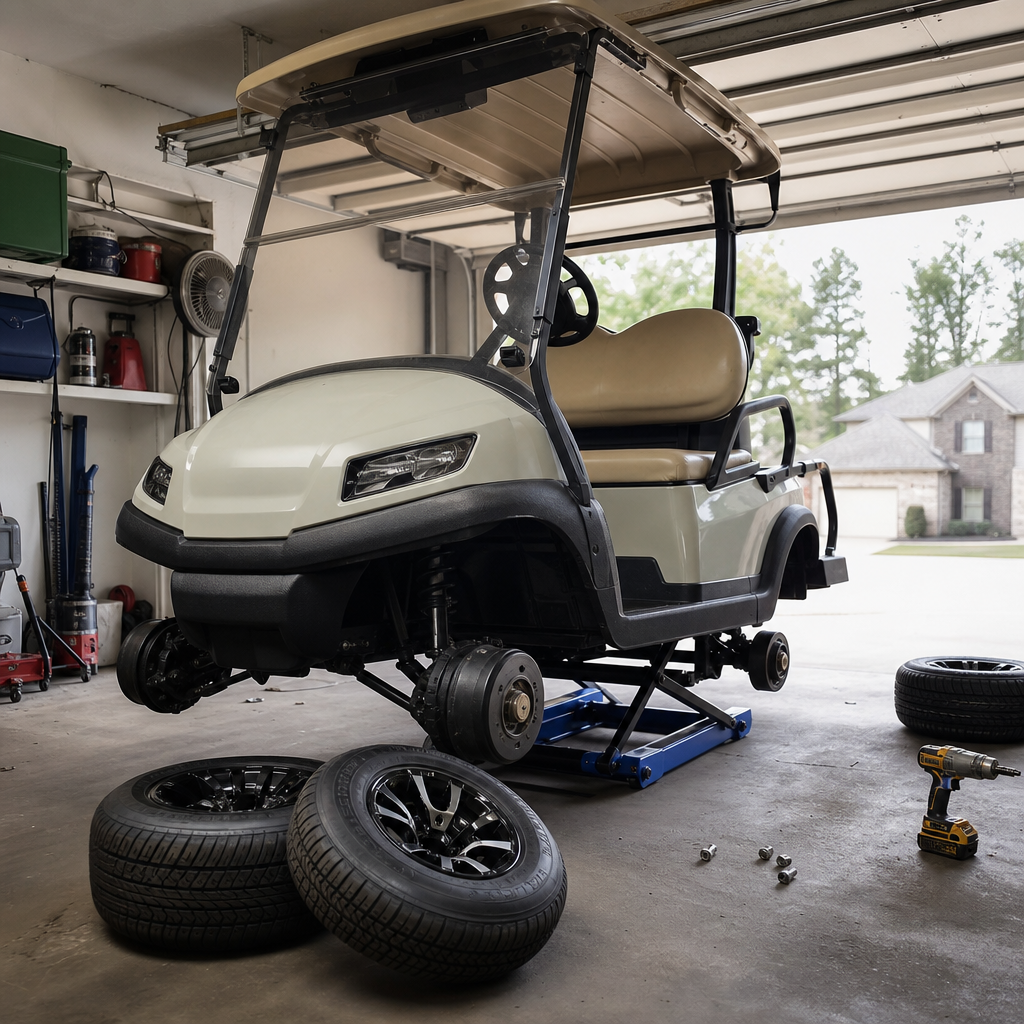
Golf cart brake work at your home runs $75 for an adjustment, $100–$250 for shoes and drums, and $200–$400 for a full overhaul; tires run $75–$150 each installed, $300–$600 for a set of four. The tech comes to your driveway anywhere in Surprise, Sun City, Sun City West, El Mirage, or Peoria and does the work at the cart, because nobody should be trailering a cart across town over a brake adjustment.
Brakes and tires are the unglamorous half of cart maintenance, and in this area they matter more than most owners realize: thousands of West Valley carts share public 35-mph streets with full-size traffic every day. That’s not a toy-maintenance context. That’s vehicle maintenance.
Why brakes quietly get bad here
Most golf carts use mechanical drum brakes: shoes, drums, and a cable linkage, closer to a 1960s pickup than a modern car. They work fine, but they drift out of adjustment gradually as shoes wear and cables stretch. And because the change is gradual, owners adapt: press a little harder, brake a little earlier. Nobody notices until a golf cart pulls out of a Sun City Grand cross street and the hard stop isn’t there.
Signals that it’s time:
- Pedal travel grows: you’re pressing farther before anything happens.
- Squeal or grind: squeal means wear; grind means the shoe is gone and the drum is being machined by your commute to the rec center. Grinding turns a $150 job into a $400 one.
- Pulling to one side under braking. One side is doing all the work.
- The parking brake won’t hold on the garage apron or a driveway slope.
The fix order is what you’d hope: adjustment first (~$75) if the hardware is healthy, shoes and drum service ($100–$250) when they’re worn, and a full overhaul ($200–$400), shoes, hardware, cables, when the system is tired end to end. We show you the parts and quote flat before touching anything, same as every job on our pricing page.
Street-legal carts: brakes are the law, not a suggestion
Arizona keeps neighborhood electric vehicles off roads posted above 35 mph (A.R.S. 28-966), and street carts in Sun City, Sun City West, and Sun City Grand follow the same line. But street use comes with equipment obligations: working brakes, and for street operation, lights and turn signals, plus liability insurance and a licensed driver. Vehicles built to do more than 20 mph fall under the federal low speed vehicle standard.
Practically, that means the cart you drive to Safeway shares lane space with SUVs whose drivers barely register a cart’s presence. Your brakes are the entire margin. We treat brake work on street carts with the seriousness of automotive work: adjustment specs, hardware inspection, cable condition, and a test drive that includes a genuine hard stop, not a parking-lot roll.
Tires: the desert eats them from the outside in
West Valley tires rarely die of tread wear. They die of heat and sun. Summer pavement here holds well above 140°F, the grit is abrasive, and UV exposure hardens rubber year-round. The result is the classic Arizona cart tire: half its tread left, sidewalls cracked like dry riverbed. A cracked tire is finished no matter the tread, sidewall failure at 18 mph on Meeker Boulevard is not a place to economize.
What we install, at your cart:
| Tire work | Installed price |
|---|---|
| Single tire | $75–$150 |
| Set of four | $300–$600 |
| Lifted / low-profile styles | quoted by size |
Standard turf tires suit most golf and neighborhood carts; street-tread styles make sense for carts that live on pavement; lifted carts take taller sizes at higher prices. Uneven wear is worth flagging: feathering or one-shoulder wear usually means an alignment or suspension issue worth catching early.
Bundled with the rest of the visit
Brakes and tires ride along naturally with other work. Every tune-up service includes a brake and tire check, and if we’re already at your home for a battery replacement, adding a brake adjustment costs the adjustment, the trip fee doesn’t double. A new lithium pack also takes about 200 pounds off the cart, which the brakes will thank you for; the tires, less so if they’re cracked.
One honesty note, consistent with everything on the about page: we’re an independent service working on all major brands, Club Car, E-Z-GO, Yamaha, ICON, Evolution, not an authorized dealer for any of them. Brake and tire work doesn’t touch factory warranties in most cases, but if your cart’s under warranty and the issue might be covered, we’ll tell you to call your selling dealer first.
If the pedal feels long, the stop feels soft, or the sidewalls look like a dry lakebed, send us the symptom and the cart model. Flat quote, same-day or next-day window, fixed in your driveway.
Frequently Asked Questions
How much does golf cart brake work cost?
A brake adjustment runs about $75, new shoes or drum work $100–$250, and a full brake overhaul $200–$400, all done at your home. If you hear grinding or the pedal travels farther than it used to, sooner is cheaper than later.
What do golf cart tires cost installed?
$75–$150 per tire installed, or $300–$600 for a set of four; lifted and low-profile street styles run higher. We mount them at your cart, so there's no hauling wheels to a shop.
How do I know my cart brakes need attention?
Longer pedal travel, squealing or grinding, pulling to one side when stopping, or rolling on the garage slope with the pedal down. Most carts use mechanical drum brakes that go out of adjustment gradually, owners adapt without noticing until a hard stop shows the truth.
Do Arizona conditions really wear tires differently?
Yes. Constant 100°F+ pavement, abrasive desert grit, and UV exposure age rubber fast, West Valley cart tires often dry-rot and crack before the tread wears out. A tire with cracked sidewalls is done regardless of tread depth, especially on a street-driven cart.
Are brakes and lights actually required on street-legal carts?
On public streets, yes. Carts on Surprise and Sun City Grand streets need working equipment including brakes, and street use requires lights and signals plus insurance and a licensed driver. On a cart sharing 35-mph roads with F-150s, brakes are the safety system, we treat them that way.
More golfcart services
Areas we serve
- Surprise, AZ
- Mobile Golf Cart Repair in El Mirage, Arizona
- Mobile Golf Cart Repair in Peoria, Arizona
- Mobile Golf Cart Repair in Sun City Grand
- Mobile Golf Cart Repair in Sun City West
- Mobile Golf Cart Repair in Sun City, Arizona
- Mobile Golf Cart Repair in Sun Village, Surprise
- Mobile Golf Cart Repair in Youngtown, Arizona